Friday 10th April 2026
Investment perspective: oil prices as the key transmission risk
Oil prices act as the conflict’s pressure valve, fuelling inflation, squeezing growth, and reshaping markets, while investors thrive not on prediction but on resilience through diversification, selectivity, and durability beyond the headlines.
From an investment adviser’s perspective, a key risk arising from the recent escalation in the Middle East is the outlook for oil prices. While geopolitical developments often dominate headlines, oil prices represent the primary mechanism through which conflict can influence inflation, economic growth and financial markets.
Periods like this often feel predictable in hindsight. In reality, conflicts of this nature are highly uncertain in real time. Investors may be tempted to assume they know how events will unfold or position portfolios around a single anticipated scenario. But this creates a binary outcome: either being completely right or materially wrong. For long‑term investors, resilience matters far more than prediction. Portfolios need to function across a range of possible futures, not just the one that dominates the headlines today.
The conflict heightens uncertainty around global energy trade, particularly through the Strait of Hormuz, a critical transit route for a material share of global oil and liquefied natural gas (LNG) flows. Disruption to production or transportation through this corridor increases the probability of sustained upward pressure on oil prices.
The United States and Iran have recently announced a temporary ceasefire and tentative steps to reopen the Strait of Hormuz. While this has reduced near‑term risks, physical oil flows remain constrained, confidence around shipping has yet to fully normalise, and the risk of renewed disruption remains elevated.
Why oil prices matter for markets
Oil prices act as an economy‑wide input cost given their vital role in electricity production and transport. If sustained at elevated levels, they can slow economic activity by raising costs for businesses and households. At the same time, they add to inflationary pressures. This increases the risk of weaker economic growth occurring alongside higher inflation, complicating the policy response of central banks.
What makes this period more challenging is that equity markets entered with full valuations. Expectations for the future were already optimistic. When uncertainty rises from a higher starting point, markets have less buffer to absorb negative surprises. Elevated oil prices can influence future earnings expectations. When expected earnings fall, share prices typically adjust well before the data shows up. This is why it is important to avoid anchoring investment decisions to short‑term narratives that may not fully reflect how uncertainty flows through to valuations.
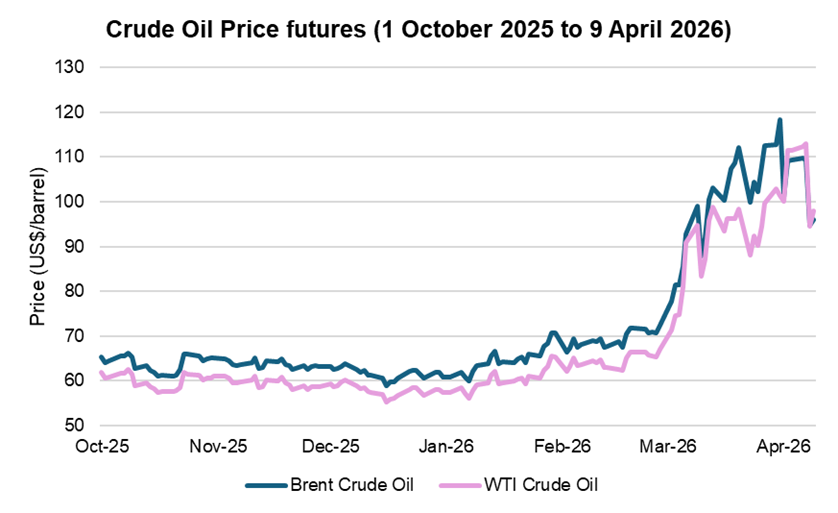
Oil prices remain well above pre‑conflict levels, having briefly surged above recent highs before easing on ceasefire headlines. This reinforces that the more important question for investors is how long prices stay elevated, not the size of the initial move.
From an Australian perspective, sustained oil driven inflation would increase the likelihood that interest rates remain higher for longer than otherwise expected.
What this means for investors
If oil prices remain elevated, the impacts are unlikely to be evenly distributed. Energy intensive sectors such as transport, airlines, logistics and parts of manufacturing face rising cost pressures, while some energy producers and resources businesses may benefit in the near term.
The transmission of risk is not uniform across sectors. Businesses with heavy exposure to energy costs are structurally more vulnerable to sustained higher oil prices. Energy producers, parts of the resources sector, and infrastructure assets with inflation‑linked contracts are better positioned to absorb or even benefit from these conditions. Understanding these dynamics reinforces why selectivity is critical in periods of uncertainty.
Investors with well‑diversified portfolios do not need to make abrupt changes in the current environment. This period should be watched closely rather than reacted to quickly. History shows that the duration and scale of an oil shock matter far more than the initial price spike. Markets can absorb short‑lived disruptions, but prolonged supply constraints carry more serious economic consequences. Risks rise if oil production or transport routes remain disrupted, particularly through critical chokepoints such as the Strait of Hormuz.
The question now is whether equity markets have fully reflected these risks, especially given full valuations and earnings sensitivities.
Recent market moves suggest investors are increasingly pricing a contained or short‑lived disruption. Markets appear less prepared for a scenario where oil prices remain elevated due to ongoing shipping constraints or renewed geopolitical flare‑ups.
Positioning for resilience
From a portfolio construction perspective, the most important discipline is not predicting the path of the conflict. It is managing position sizing and avoiding undue concentration. Many Australian investors naturally overweight the major banks or large commodity producers. This can create unrecognised vulnerabilities if economic growth slows or global demand weakens. Selectivity within asset classes, favouring quality balance sheets, resilient cashflows, and sensible diversification, provides far more protection than attempts to time market reactions.
On balance, a more defensive portfolio positioning remains appropriate while interest rates are elevated and risks to growth persist. Within equities, selectivity remains critical. The emphasis should be on earnings resilience and conservative growth assumptions, rather than reliance on continued momentum.
Fixed income continues to play a valuable role in a diversified portfolio, particularly when uncertainty is elevated. Floating rate securities remain attractive in the current interest rate environment. High‑quality fixed rate bonds can provide protection in the event of a deeper downturn. If expectations for future interest rates rise in the short term, this can put downward pressure on longer‑duration bond prices. It is another reminder that balance, not binary bets, delivers resilience.
A resilient approach in uncertain times
Successful investing is less about predicting outcomes and more about ensuring portfolios remain resilient across different scenarios. In the current environment, the signal that matters most is whether oil prices remain elevated, and for how long, given it is the clearest transmission mechanism into inflation, earnings expectations and ultimately market pricing. It is critical to note, however, that diversification across different investment options will help shelter your portfolio from the worst-case possibilities.
Any advice included in this article is general only and has been prepared without taking into account your objectives, financial situations or needs. Before acting on the advice you should consider whether it’s appropriate to you, in light of your objectives, financial situation or needs. You should also obtain a copy of and consider the Product Disclosure Statement for any financial product mentioned before making any decisions. Past performance is not a reliable indicator of future performance. Advisers at Pitcher Partners Sydney Private Wealth (‘PPSPW’) are authorised representatives of Pitcher Partners Sydney Private Wealth Pty Limited, ABN 25 678 662 925, AFS Licence No. 563803. PPSPW is part of the Pitcher Partners Sydney Firm and is a privately owned and run company associated with the Pitcher Partners network of separate accounting firms and is a network member of Baker Tilly International Limited.

Andrew is a partner at Pitcher Partners and a Barrons 150 adviser.